
Real change happens between the training sessions
Many traditional one-day and multi-day seminars generate a knowledge high effect: participants are highly motivated, take their new ideas with them—and a few days later, everyday life returns. What is missing? Time for integration, trial and error, reflection, and transfer.
From my personal development and also my many years of experience as an HR consultant and specialist for learning and development, trainer, and coach with different training formats, I know that lasting change does not happen in a day. This is quite unfortunate, as we all wish for it. And it is a fact. It requires steps, breaks, and the space to try out what you have learned in everyday life.
That's why my training courses are modular in structure.
The decisive factor happens between the modules – and this is completely free of charge: Behavior changes – and this transformation flows back into the next unit. This allows us to make targeted adjustments, deepen our knowledge, and then tackle new content.
That's why I believe that modular training goes deeper and has a more lasting effect.
One-day seminar vs. training in modules – the difference in pictures
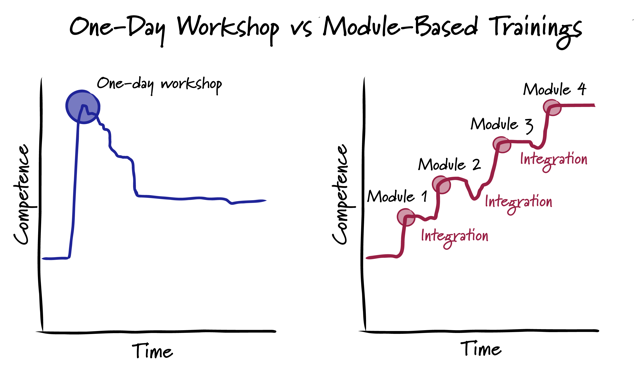
- One-day seminar: Knowledge curve rises steeply—and falls quickly when everyday life pushes good intentions aside.
- Modular training: The curve rises, does not flatten out, but continues to grow with each module – because content is integrated into everyday life and consolidated.
The advantages of modular trainings

- Sustainability: Behavioral skills improve step by step
- Transfer: What has been learned is tried out in everyday life – feedback follows in the next module
- Individual adaptation: Topics can be linked to real-life situations
- Trainer as contact person: Readjustment, providing situational impetus
- Lasting results: New habits instead of short-term motivation
- Strengthening through resonance: Participants are seen as individuals
Your concerns? Let's talk about them.
"Why not just a one-day seminar?"
In my experience, one day can impart knowledge, but it can hardly change behavior. We humans are creatures of habit and, after seminars, we first need the courage, time, and opportunity to try out what we have learned. In contrast, participants in modular training courses have the self-imposed task of trying out new things, gaining experience, and making adjustments in the next step between modules. This is how knowledge becomes competence.
"We don't have time for multiple modules."
Precisely because time is so limited, training that is effective in everyday work is crucial. A one-off training day, on the other hand, is quickly forgotten. Several short, coordinated units bring lasting results – and save time, costs, and frustration in the long term.
"Isn't that more expensive than a one-day seminar?"
Yes – at first glance. Just the travel costs for participants alone. But the return on investment is significantly higher because knowledge is turned into lived and applied competence. In short: less friction, more productivity, less fluctuation.
"Do you offer one day or two day trainings?"
Yes – the moment the development team of the company and I get together and come up with processes and activities to guide the participants before and after the training, we maximize chances that real change takes place.
"How do we ensure that people stay on track between sessions?"
I design each session so that each participant focuses on their own challenges and takes these tasks with them into their everyday life. This allows participants to bring their experiences to the next module. This makes learning engaging and lively.
What customer say about me:
Do you have any questions? Let's talk.
Choose the path that suits you best
Send me an email or use the contact form to describe your request.
Book an introductory meeting. We will discuss your challenges and see if my approach fits your goals.